Welding
- Apr 5, 2023
- 4 min read
Updated: Mar 7, 2024
Welding is the process of joining two or more pieces of metal or thermoplastics through heating, melting, and cooling. It is a critical process in manufacturing, construction, and repair industries. Welders use various techniques and equipment, such as welding machines, electrodes, and gas torches, to fuse the materials together. The field of welding offers various career opportunities, from entry-level welding jobs to high-paying welding engineering positions. If you're interested in a career in welding, there are many excellent educational programs and apprenticeships available in Australia.

1. Admissions Guide for Welding in Australia
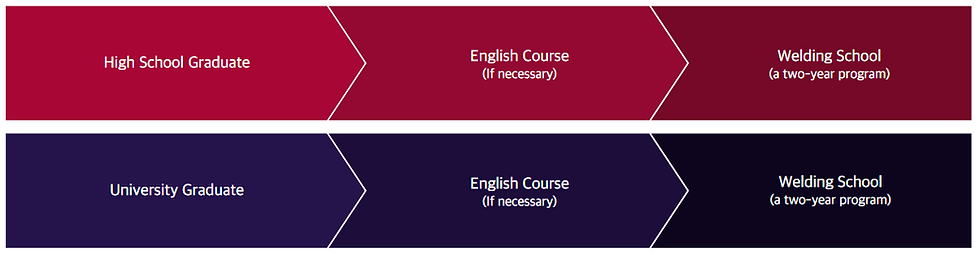
This diagram provides a brief guide to the admission process for high school and university graduates who wish to study Welding in Australia.
2. Entry Requirements for Welding Studies in Australia
The table below outlines the minimum entry requirements for international students who are interested in pursuing studies in Welding in Australia. Entry requirements are categorized into academic and English language requirements. For detailed admission requirements, please consult with an Australian Study Abroad Counselor (QEAC).
Note: These requirements may vary depending on the institution.
Qualification | IELTS | Academic Requirement |
Certificates | 5.5 (no band less than 5.0) | Year 11 |
Diploma | 5.5 (no band less than 5.0) | Year 12 with ATAR |
3. Structure of Welding Courses in Australia
The following table provides an overview of the structure of a typical welding course in Australia. It outlines the key components of the course and briefly describes what each component covers. This information can be useful for students who are interested in pursuing a career in welding and want to gain a better understanding of the different areas of knowledge and skills that they will acquire through the course.
Component | Description |
Welding Safety | Covers safety procedures and equipment used in welding. |
Welding Procedures | Covers different welding techniques, including gas metal arc welding (GMAW), gas tungsten arc welding (GTAW), shielded metal arc welding (SMAW), and flux-cored arc welding (FCAW). |
Welding Theory | Covers the scientific principles of welding, such as metallurgy, heat transfer, and welding defects. |
Workplace Communication | Covers the communication skills necessary for effective teamwork and workplace communication. |
Practical Training | Involves hands-on training in welding techniques and procedures. |
Industry Placement | Provides an opportunity for students to gain practical work experience in the welding industry. |

4. List of Welding Schools in Australia
This table provides a comprehensive list of welding schools located in various states and territories across Australia. The schools listed offer a range of courses and programs related to welding, including welding techniques, welding theory, welding safety, and industry placement. Prospective students and individuals interested in pursuing a career in welding can use this table as a resource to explore available options for welding education in Australia.
STATE/TERRITORY | INSTITUTION |
NSW | Superior Training Centre (STC) (2024 x) InTech Institute of Technology Lead College Signet Institute og Australia |
VIC | Baxter Institute The Learning Professionals (LP) State Institute of Training (SIT) |
QLD | Intech Institute of Technology |

5. Hierarchy of Welding Positions and Descriptions
The table below provides an overview of the positions in the Welding hierarchy in Australia, ranging from entry-level positions to executive roles. Responsibilities and required skills increase with each position, with higher positions generally requiring more experience in managing a team of welders, providing customer service, and ensuring efficient and effective welding services.
Note: the positions and descriptions may vary depending on the specific organization or institution.
Position | Description |
Welding Apprentice | Typically an entry-level position with no formal qualifications, but undergoing an apprenticeship program to learn welding techniques and procedures. |
Welder | Read welding blueprints, select necessary parts and handle welding techniques and machines. They choose appropriate welding techniques based on the conditions of the welding site and perform their duties while complying with safety regulations. |
Welding Inspector | Inspects and tests welded joints for defects and ensures compliance with welding standards and regulations. |
Welding Supervisor | Manages a team of welders, assigns tasks, and ensures the quality and efficiency of welding operations. |
Welding Engineer | Designs welding procedures and develops welding specifications for a range of projects. |
Welding Manager | Oversees all welding operations, manages budgets, and ensures compliance with safety regulations and quality standards. |
Executive Roles | May include positions such as Chief Welding Officer or Director of Welding Operations, responsible for overall strategy and direction of welding operations in a company or organization. |

6. Career Information for Welding in Australia
The table below presents a summary of the career path and future prospects for individuals who are interested in pursuing a career in Welding in Australia. It provides essential information on job prospects, employment size, expected job growth rate, average salary, employee percentage, female employment rate, and the average age of workers in this field. This information can serve as a useful resource for students who are considering a career in Welding and want to gain insights into the potential opportunities and challenges in this industry.

Occupation | Structural Steel and Welding Trades Workers (ANZSCO ID 3223) |
Job Type | Technicians And Trades Workers |
Skill Level | Medium skill |
Unemployment Rate | Below average |
Employed | 82,600 |
Future Growth | 2.1% |
Weekly Earnings | A$1,760 |
Full - Time Share | 90% |
Female Share | 1% |
Average Age | 38 |

7. Immigrating to Australia through Welding
The diagram below provides an overview of the general process for immigrating to Australia through Welding courses, including available visa options and the information on related occupations for welders.

Skilled Independent visa (Subclass 189) | Skilled Nominated visa (Subclass 190) | Skilled Work Regional (Provisional) visa (Subclass 491) | Temporary Skill Shortage visa (Subclass 482) | Skilled Employer Sponsored Regional (Provisional) visa (Subclass 494) |
O | O | O | O | O |
Occupation | ANZSCO | List | Visa | Accessing Authority |
Fitter-Welder | 323213 | MLTSSL | Subclass 186 Subclass 189 Subclass 190 Subclass 482 Subclass 186 Subclass 494 Subclass 491 | TRA |
Pressure Welder | 322312 | MLTSSL | Subclass 186 Subclass 189 Subclass 190 Subclass 482 Subclass 186 Subclass 494 Subclass 491 | TRA |
Welder (First Class) | 322313 | MLTSSL | Subclass 186 Subclass 189 Subclass 190 Subclass 482 Subclass 186 Subclass 494 Subclass 491 | TRA |
Metal Fabricator | 322311 | MLTSSL | Subclass 186 Subclass 189 Subclass 190 Subclass 482 Subclass 186 Subclass 494 Subclass 491 | TRA |

Comments