Architecture
- Mar 21, 2023
- 5 min read
Updated: Mar 21, 2025
Architecture is the art and science of designing buildings and structures. Architects use creativity and technical knowledge to create functional and aesthetically pleasing spaces. Studying architecture in Australia can provide students with a unique blend of design, technology, and sustainability. Graduates can pursue careers in a variety of fields including urban design, landscape architecture, and construction management.

1. QS World University Rankings by Subject 2025: Architecture
Australian universities are highly regarded in the field of architecture education, with RMIT University and UNSW Sydney ranking among the top institutions globally. The University of Melbourne and The University of Sydney also achieved strong rankings, further solidifying Australia's reputation for excellence in architectural education. Additionally, Curtin University and Queensland University of Technology (QUT) have well-regarded architecture programs, placing them among the top institutions worldwide. Pursuing an architecture degree in Australia provides students with access to high-quality education, innovative research, and opportunities to excel in this dynamic field.
Rank | Australian University |
21 | RMIT University |
23 | UNSW Sydney |
26 | The University of Melbourne |
30 | The University of Sydney |
101-150 | Curtin University |
101-150 | Queensland University of Technology |
2. Admissions Guide for Architecture in Australia
This diagram provides a brief guide to the admission process for high school and university graduates who wish to study Architecture in Australia.
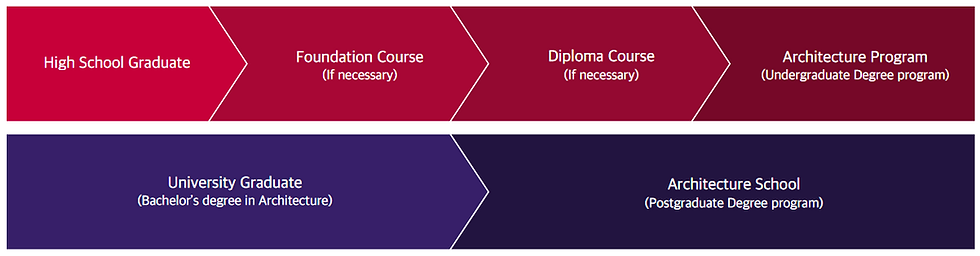
3. Entry Requirements for Architecture Studies in Australia
The table below provides an overview of the minimum entry requirements for international students who are interested in pursuing studies in Architecture in Australia. The entry requirements are classified into academic and English language requirements. It is important to note that admission requirements may differ based on the institution. For comprehensive admission requirements, it is recommended to seek advice from an Australian Study Abroad Counselor (QEAC).
Qualification | Duration | IELTS | Academic Requirement |
Bachelor's degree | 3 years | 6.0 (no band less than 6.0) | High school diploma |
Master's degree | 2 years | 6.5 (no band less than 6.0) | Bachelor's degree in Architecture |

4. Structure of Architecture Courses in Australia
The table below presents an outline of the structure of an Architecture course for international students in Australia. It provides a summary of the essential components of the course and offers a brief description of each component. This information is helpful for students who intend to pursue a career in architecture and desire to acquire a comprehensive understanding of the various fields of expertise and abilities they will develop through the course.
Note: The components and course structure may vary depending on the institution and specific course.
Component | Description |
Studio Practice | Studio practice is a fundamental component of Architecture courses in Australia. Students will undertake a series of studio-based design projects to develop their design skills, techniques and abilities. |
Architectural History and Theory | Students will explore the history, theory and cultural significance of architecture, including its social and environmental impact. |
Technology and Materials | This component of the course teaches students about construction technology, building materials, and structures. |
Building Systems and Services | This component covers the various building systems, such as HVAC, electrical, and plumbing, that are essential for designing sustainable and efficient buildings. |
Professional Practice | This component prepares students for the professional practice of architecture, including legal, ethical and business considerations. |
Field Work and Industry Experience | Some institutions may offer fieldwork opportunities or internships, where students can gain hands-on experience in real-world projects and engage with industry professionals. |
Design Electives | Students may have the option to choose design electives that align with their interests and career goals, such as landscape architecture or urban design. |
Final Project | In the final year of the course, students are required to complete a major design project that integrates the knowledge and skills they have gained throughout the course. |

5. AACA (Architects Accreditation Council of Australia) Accredited Programs List
The AACA (Architects Accreditation Council of Australia) maintains a list of accredited architecture programs offered by various institutions across different states and territories in Australia. The accreditation process ensures that the programs meet the required standards for architecture education and training in Australia. Prospective architecture students or architects seeking to practice in Australia should consult this list to ensure they enrol in an accredited program.
STATE/TERRITORY | INSTITUTION |
NSW | University of Sydney University of New South Wales University of Technology, Sydney University of Newcastle Western Sydney University |
VIC | Royal Melbourne Institute of Technology Deakin University University of Melbourne Monash University Swinburne University of Technology |
QLD | Bond University The University of Queensland Queensland University of Technology Griffith University |
WA | University of Western Australia Curtin University |
SA | University of Adelaide University of South Australia |
ACT | University of Canberra |
TAS |
|

6. Hierarchy of Architecture Positions and Descriptions
The table outlines the positions in the architecture hierarchy in Australia, from Junior Architect to Senior Architect. Responsibilities and required skills increase with each position, with higher positions requiring experience in managing a team, leading complex projects, and providing advanced architectural expertise.
Note that the positions and descriptions may vary depending on the architecture firm or organization.
Position | Description |
Junior Architect | A recent graduate or entry-level position. The junior architect assists senior architects and performs basic design and drafting tasks, such as creating project drawings, models, and research. |
Intermediate Architect | Mid-level position with several years of experience. The intermediate architect takes on more responsibility in project management, design development, and coordination. They may also oversee and mentor junior architects. |
Project Architect | Leads the design and development of specific projects, collaborating with other architects, engineers, and contractors. They are responsible for project timelines, budgets, and ensuring the project meets the client's needs and requirements. |
Senior Architect | An experienced architect with a broad range of skills and expertise. They lead the design and development of complex projects, oversee project teams, and provide advanced technical guidance. They are also involved in business development and client relations. |

7. Registration and Career Information for Architecture in Australia
The table below shows the process and future directions for becoming an architect in Australia. Additionally, it provides information on the employment size, future job growth rate, average salary, employee percentage, female employment rate, and the average age of the architect profession in Australia.

Occupation | Architects and Landscape Architects (ANZSCO ID 2321) |
Job Type | Professionals |
Skill Level | Very high skill |
Unemployment | Below average |
Employed | 46,100 |
Future Growth | 16.8% |
Weekly Earnings | A$1,827 |
Full - Time Share | 81% |
Female Share | 34% |
Average Age | 39 |

8. Immigrating to Australia through Architecture
The diagram below provides an overview of the general process for immigrating to Australia through the Australian Architecture Program, including available visa options and Architecture-related occupations.

Skilled Independent visa (Subclass 189) | Skilled Nominated visa (Subclass 190) | Skilled Work Regional (Provisional) visa (Subclass 491) | Temporary Skill Shortage visa (Subclass 482) | Skilled Employer Sponsored Regional (Provisional) visa (Subclass 494) |
O | O | O | O | O |
Occupation | ANZSCO | List | Visa | Accessing Authority |
Architect | 232111 | MLTSSL | Subclass 186 Subclass 190 Subclass 482 Subclass 187 Subclass 491 Subclass 494 | AACA |
Landscape Architect | 232112 | MLTSSL | Subclass 186 Subclass 190 Subclass 482 Subclass 187 Subclass 491 Subclass 494 | VETASSESS |

Comments